A Different Starting Point in the AI Cycle
Flitto was built long before the recent generative AI wave, on a strategic foundation of multilingual data infrastructure.
For over a decade, the company has systematically constructed high-quality, copyright-safe datasets and evolved them into scalable AI solutions.
Today, Flitto stands as the only South Korean AI language data company operating on a global platform, with over 14 million accumulated users, more than 2,900 partners, and services across 173 countries.
This long-term consistency has now translated into measurable financial results.
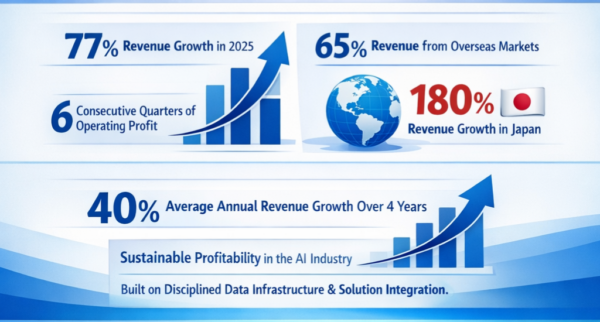
In 2025, Flitto achieved 77% year-over-year revenue growth and recorded six consecutive quarters of operating profit. More than 65 percent of total revenue now comes from overseas markets, reflecting accelerating global demand for high-quality AI training data. evenue in Japan increased by 180%, demonstrating strong adoption in one of the world’s most quality-sensitive and competitive language markets. Over the past four years, the company’s average annual revenue growth rate has reached 40 percent.
In the AI industry, rapid expansion is often emphasized. Structural profitability, however, is far less common.
Flitto’s performance reflects an AI model grounded in disciplined data infrastructure and solution integration.
The Structural Advantage: Data × AI Solution
Flitto’s business identity is defined by the synergy between Data Biz and AI Solution.
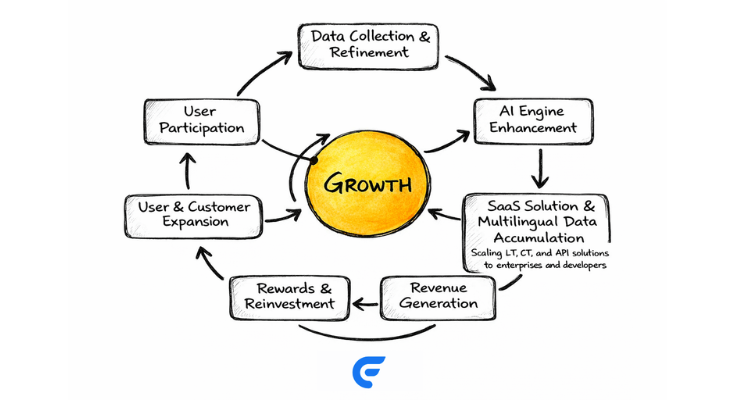
The model operates as a continuous flywheel:
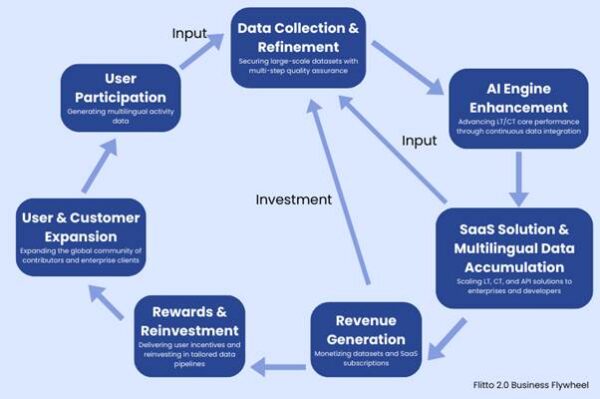
- Construction of high-quality, copyright-safe multilingual datasets
- Delivery of AI training data to global enterprises
- Deployment of AI multilingual solutions
- Collection of real-world usage data
- Continuous retraining and quality enhancement
As demonstrated in Flitto’s AI Data Construction Pipeline, API-based workflows, human-in-the-loop verification, and multi-layered quality control ensure both scale and precision.
This infrastructure-driven framework enables stable AI advancement, domain-specialized language adaptation, and long-term performance optimization across industries and use cases.
Growth, therefore, is the outcome of a scalable data-to-solution ecosystem built on structured infrastructure and continuous improvement.
The Next Phase of AI: From Generation to Hyper-Personalization
AI has progressed from automation to generation. The next shift is already visible: systems capable of understanding context, intent, and individual variability in real time.
At CES 2026, hyper-personalized AI emerged as a defining mainstream trend. (“Cinemo at CES 2026: Hyper-Personalized Experiences in the Car and Beyond”) Across industries, AI is moving beyond generalized assistance toward individualized intervention, adapting to personal documents, domain-specific terminology, speech patterns, and multilingual interaction contexts to deliver tailored outcomes.
Delivering this level of adaptability requires disciplined infrastructure: multilingual datasets that are continuously refined through live usage and reintegrated into learning systems.
For over a decade, Flitto has built and strengthened such infrastructure across global markets and industries. As deployed solutions generate contextual data and feed it back for refinement, capability compounds.
When infrastructure, deployment, and adaptive learning converge, intelligence shifts from reactive output to contextual understanding.
This is how Hyper-Personalization becomes a long-term competitive advantage.
How Flitto Implements Hyper-Personalization
Flitto has embedded Hyper-Personalization directly into its AI interpretation and translation solutions.
Chat Translation is built upon years of accumulated high-quality multilingual datasets combined with Speech-to-Text (STT) technology. It supports real-time multilingual communication across online and offline environments in up to 37 languages.
Its significance, however, extends beyond real-time translation. Hyper-Personalization is implemented at the data layer.
Through Chat Translation, Flitto enables:
• The creation of individualized datasets based on user-uploaded materials such as business documents, research papers, LinkedIn profiles, and other professional content
• The integration of domain-specific terminology and personal language preferences into translation outputs
• Automatic recognition of mixed-language interactions within live conversations
• Continuous learning from real-time communication patterns through features such as Quick Chat
• Iterative refinement of translation accuracy as usage accumulates
This approach embeds personalization directly into the infrastructure itself.
From an AI evolution perspective, this shift is meaningful.
Traditional AI models rely on large-scale generalized datasets to produce statistically optimized outputs. Flitto’s approach reintegrates real-world contextual usage data back into the learning pipeline. As solutions are deployed and used, they generate structured linguistic signals that strengthen the dataset and enhance future performance.
In this model, data improves, models evolve through usage, and translation advances toward contextual understanding.
Chat Translation therefore illustrates how Flitto’s data-to-solution flywheel operates in practice.
Hyper-Personalization, in this context, becomes the structural mechanism through which AI transitions from generalized output to adaptive intelligence.
Structural Advantage in Motion
Structural profitability is the outcome of disciplined infrastructure, integrated solutions, and compounding data cycles.
As AI moves toward Hyper-Personalization, competitive advantage will increasingly belong to companies that can continuously capture, refine, and redeploy real-world intelligence at scale.
Flitto’s strategy is built on that principle.
From data to solutions, and from solutions back to data, the cycle reinforces itself.
Over time, structure compounds.
And compounding structure is what transforms AI capability into sustainable advantage.