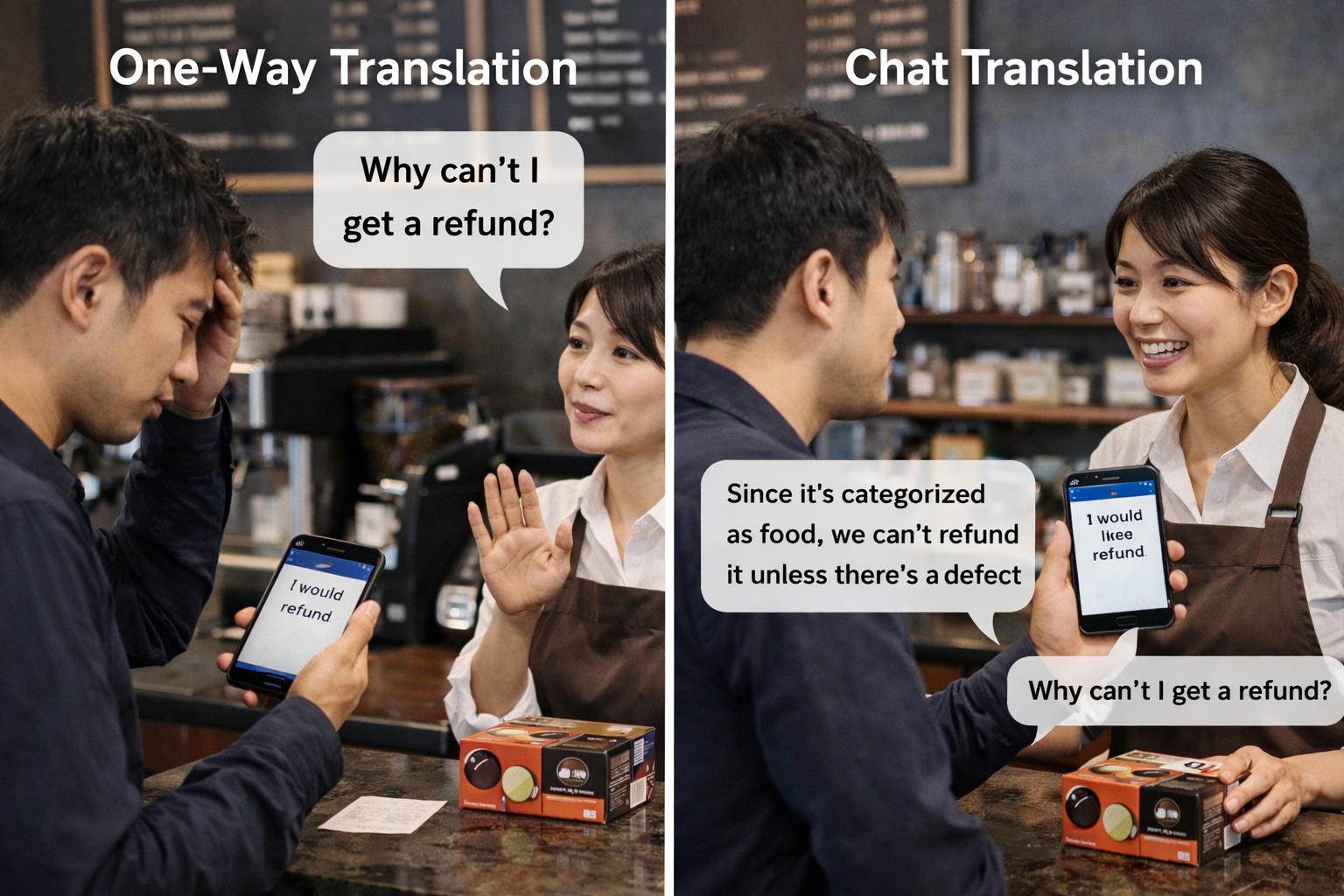
Why Certain Moments Require More Than One-Way Translation
Many travelers rely on tools like Google Translate when communicating abroad.
For simple, one-off requests, these tools often work well.
However, real-world situations are rarely that simple.
The following episode is based on an actual user experience and highlights why, in certain moments, Chat Translation (CT) is not just helpful—but essential.
A Common Travel Scenario: Refund Requests Abroad
While traveling, it is common to purchase gifts or products that later need to be partially returned.
If a refund is processed immediately, the interaction is straightforward:
A customer shows a translated sentence such as “I would like a refund”,
the store staff understands, and the refund is issued.
In this case, one-way translation is sufficient.
However, refund policies vary significantly from country to country.
In Japan, refund regulations differ from those in many other regions. In particular, food products are subject to strict rules.
Even if an item such as capsule coffee has not been opened or consumed, it is still classified as food.
Unless there is a product defect, refunds are generally not permitted.
Where One-Way Translation Breaks Down
Imagine a customer, unaware of this policy, requests a refund.
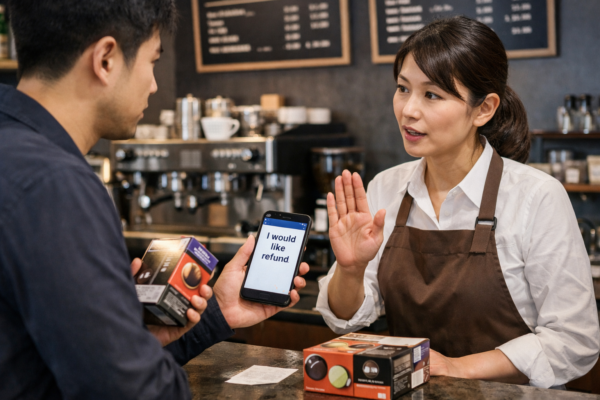
The store manager responds verbally in Japanese:
“This product is classified as food. Without a defect, refunds are not permitted.”
If the manager is not actively using a translation tool, the customer cannot understand the explanation.
At this point, the interaction requires:
- Understanding the reason behind the refusal
- Asking follow-up questions
- Receiving policy details
- Responding based on that information
Relying on one-way translation tools in this situation introduces significant friction.
The customer must repeatedly:
- Type a question
- Show the screen
- Wait for a response
- Attempt to translate the response again
This disrupts the conversation and often leads to misunderstandings or frustration.
Why Chat Translation Is Required in This Moment
This is precisely the type of situation where Chat Translation becomes essential.
With CT:
- The customer can clearly state their request
- The store manager’s response is translated in real time
- Policy explanations are fully understood
- The conversation continues naturally and contextually
For example:
With Chat Translation
- Customer: “I would like to request a refund.”
- Manager: “Refunds are not available for this product.”
(Displayed in the customer’s language)
“It is classified as food, and refunds are only possible if there is a defect.” - Customer: “The capsule coffee has not been opened.”
- Manager: “Even unopened, it is still classified as food under our refund policy.”
Through this exchange, the customer is able to understand the policy, ask relevant questions, and reach a clear conclusion, even if the refund is ultimately not possible.
The Key Difference: Translation vs. Conversation
Chat Translation is not designed for simple phrase translation.
It is designed for situations where:
- Both parties must explain, not just respond
- Context must be maintained across multiple turns
- Accurate understanding matters more than speed alone
Refund requests, medical consultations, immigration procedures, and business discussions all share this characteristic.
In these moments, communication is not one-directional.
It is a conversation.
And conversation requires more than one-way translation.
Why This Matters for Real-World Communication
This episode demonstrates a clear distinction:
- One-way translation tools are effective for simple, transactional messages
- Chat Translation is essential when communication must flow, adapt, and be understood on both sides
These are the moments CT was built for.