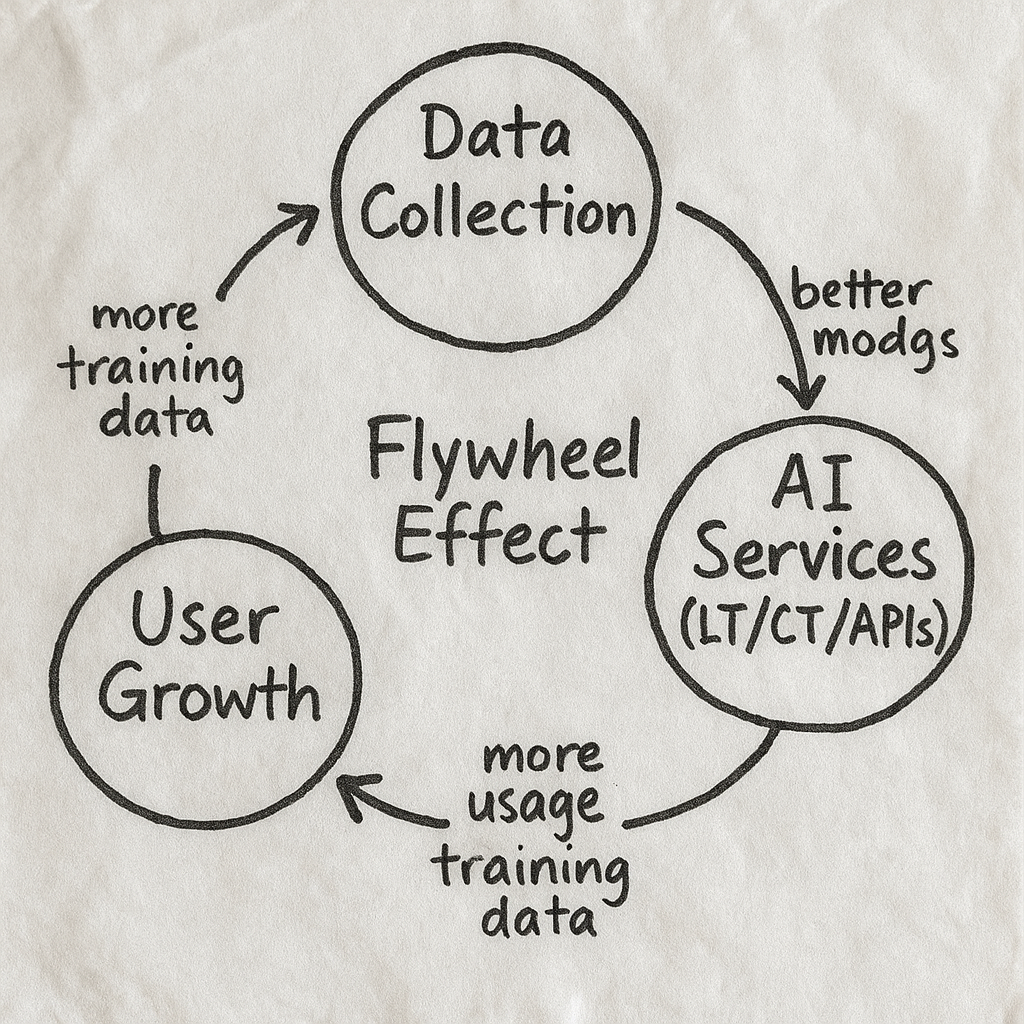
Flitto began with a clear mission: to build high-quality datasets, fast, cost-effectively, and at scale, for companies and research institutions developing AI models. Unlike today’s common approach of fine-tuning foundation LLMs with task-specific datasets, early model builders often had only the model architecture itself. As a result, they required as much training data as possible.
As we responded to these needs, our internal data volume grew rapidly. To verify whether the datasets we created were truly effective for training, we needed to train our own models and validate performance.
We therefore began tagging our accumulated text datasets with categories such as economics, medicine, law, sports, and travel, and trained models on them. Once a model was capable of automatically predicting tags for newly generated text, human reviewers only needed to validate or correct the model’s first-pass tagging, dramatically reducing the time required for manual classification.
Building on this foundation, we then challenged ourselves to develop a multilingual parallel corpus–based NMT (Neural Machine Translation) system. Today, Flitto’s NMT engine is deployed not only on our website but also in on-premise environments for defense-related and financial institutions, further validating our technological capabilities in AI.

This integrated cycle of data construction → model training → technology validation confirmed a principle we consider fundamental: “AI performance is ultimately determined by data quality.”
This principle became the backbone of Flitto’s product strategy and operational standards.
On this foundation, Flitto has continuously expanded real-time translation solutions tailored to diverse environments. Although each solution addresses different user scenarios, all of them originate from, and evolve through, the same virtuous cycle of Data → Model → Service.
Live Translation (LT)
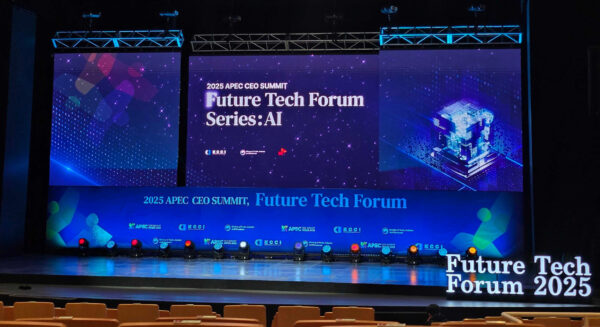
A real-time simultaneous interpretation solution used in large-scale conferences, forums, and summits, without the need for interpreter booths. LT supports up to 38 languages, providing both text and audio output simultaneously. Participants simply scan a QR code to instantly access translation in their preferred language, enabling immersive, uninterrupted listening experiences.
The LT engine is powered by domain-specific parallel corpora and the CT engine (NMT + STT + contextual inference). Feedback generated onsite continuously flows back into our data pipeline, improving accuracy for proper nouns, intonation, terminology, and culturally nuanced expressions.
Chat Translation (CT)
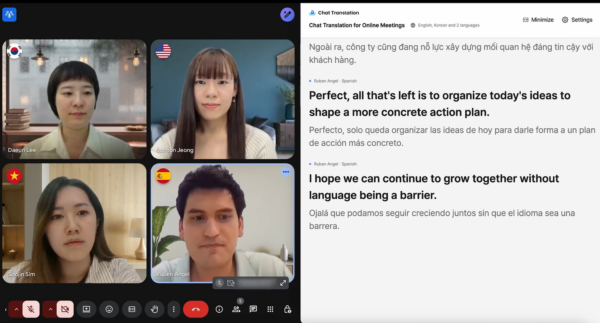
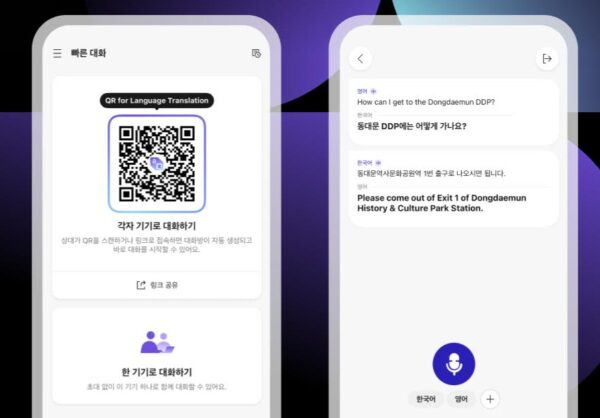
In 2025, Flitto expanded into digital collaboration with the launch of Chat Translation. The solution supports real-time translation and summarization in up to 37 languages and integrates a hyper-personalization engine that adapts to individual language patterns and document-based knowledge.
One product. Two modes – designed for different communication scenarios.
① Quick Chat (On-the-Go Conversations)
- Designed for travel, business trips, and everyday face-to-face interactions.
- Use a single device for one-on-one conversations, or instantly open a shared chat room by scanning a QR code
- no app download required for the other participant.
- Quick Chat enables fast, natural multilingual conversations anytime, anywhere.
② Online Meeting (Work & Collaboration)
- Built for remote meetings and cross-border collaboration.
- Chat Translation automatically generates meeting summaries, and accurately reflects job-specific terminology.
- By learning from your uploaded documents and materials, it delivers translations that align with your role, context, and professional language
Chat Translation Enterprise (CTE)
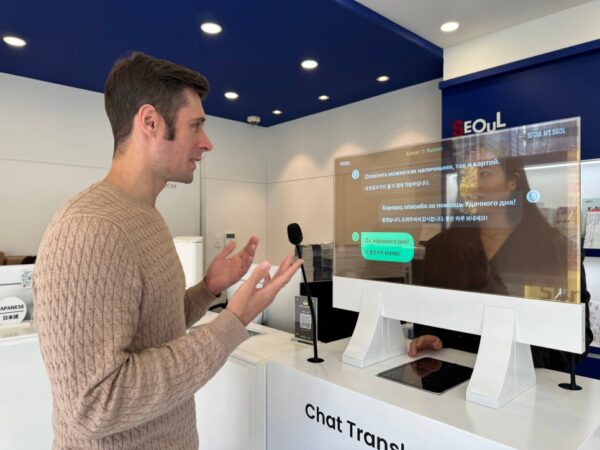
A high-precision translation solution for enterprises, public institutions, banks, tourism, and retail environments. Using a two-device setup, staff and visitors each speak in their native language, and the system automatically translates both sides.
CTE supports:
- Handling multiple simultaneous requests through fixed QR codes
- Domain-specific terminology learning
- Customization based on business documents
Actual real-world speech data, onsite conversation logs, and human-in-the-loop QC reinforce the engine, resulting in continuously strengthened accuracy as usage grows.
Image Translation

An image-based AI translation solution that recognizes text (via OCR) on menus, signs, packages, exhibitions, and more, converting it instantly into multiple languages. Users can simply scan a QR code to access the service. When necessary, clicking on translated elements can surface image-search-based contextual information.
Diverse fonts, lighting conditions, angles, and regional layout variations are incorporated into OCR and translation training, ensuring readability and accuracy across real-world scenarios.
A Continuous Cycle of Data Advancement
Across all software applications, Flitto’s foundation is the ongoing enhancement of data.
By continuously reinjecting real usage data into training—correcting mistranslations, incorporating neologisms, and addressing domain-specific discrepancies—Flitto builds self-evolving AI models whose precision increases the more they are used.
In 2025, Flitto obtained ISO/IEC 27001 certification across all translation solutions, meeting global standards for security and reliability.
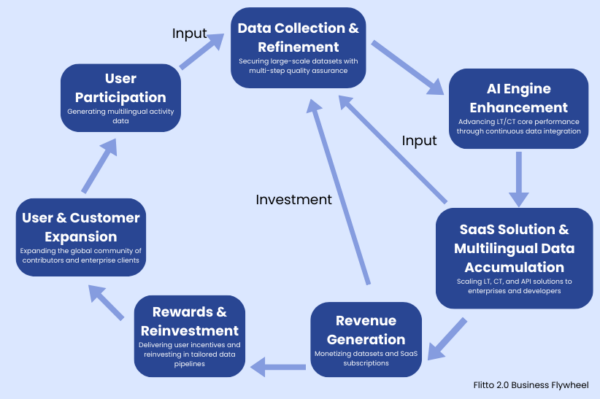
This closed-loop cycle, Data → AI Training → Service → Real Usage Logs → Back to Data
, has enabled Flitto to realize a complete, self-reinforcing system. This structure not only advances technological sophistication but also translates into tangible business performance and public-sector expansion.
Business Growth Fueled by Technological Competitiveness

Flitto has achieved rapid growth over the past several years:
- Revenue increased from KRW 5.7B in 2020 to KRW 20.3B in 2024, achieving a 5-year CAGR of 59.2%.
- Exports expanded from KRW 2.2B in 2020 to USD 8M in 2024, earning consecutive “$1M / $3M / $5M Export Tower Awards.”
- Flitto earned Korea’s first A-grade certification for CoT data quality, filed multiple patents in AI translation, and successfully completed a KOSDAQ listing via the Business Model Special Listing Program in 2019.
- The team has grown from 3 employees in 2012 to over 200 employees in 2025.