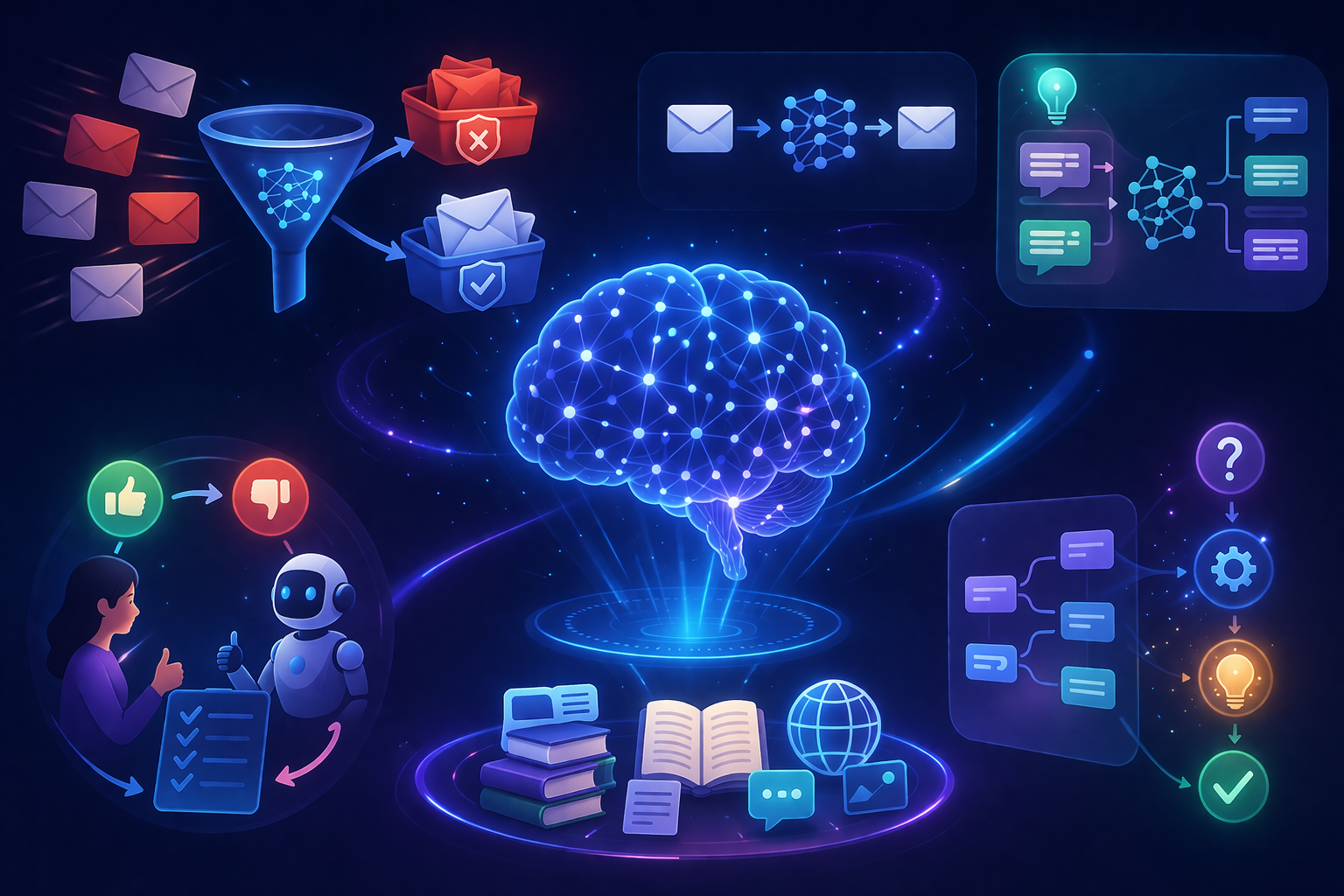
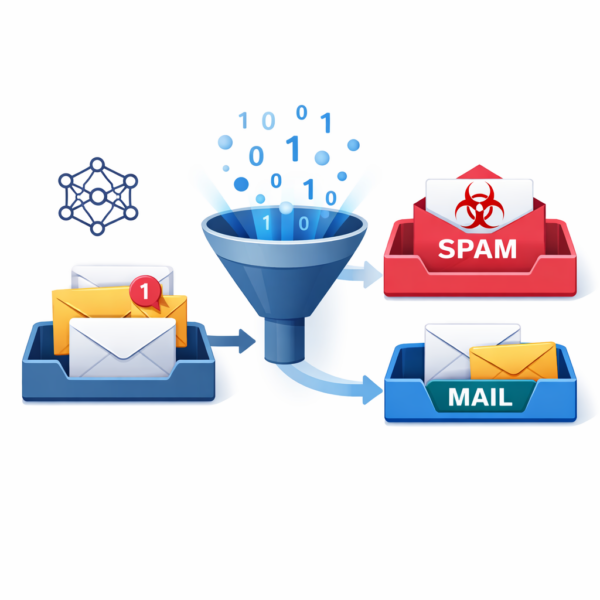
In the early days of machine learning, each model was designed for a specific task. A representative example is a spam filter, which classifies whether an incoming email is spam or not. A large volume of emails is collected, and humans review and tag each one as spam or non-spam. By training on this dataset, the model can calculate the probability that a new email is spam. If the probability exceeds a certain threshold, the email is classified as spam; otherwise, it is not.
Similarly, models that classify images into categories such as dogs, cats, or lions, or models that translate Korean sentences into English, are trained on purpose-built datasets to perform specific functions.
In contrast, large language models (LLMs), which are widely used today, are not limited to a single function. We can ask LLMs to summarize long texts, extract named entities from sentences, translate into different languages, solve math problems, or even write code. While traditional models can be seen as individual tools in a toolbox, LLMs are more like a Swiss Army knife that combines multiple tools into one.
LLMs are able to understand human language and perform a wide range of tasks because they are trained on datasets specifically designed for these functions. For example, in translation tasks, the structure of datasets differs between traditional neural machine translation (NMT) models and LLM-based approaches, as shown below.
| Model | Dataset Example |
| Traditional Model | { “src_text”: “벚꽃이 활짝 피었습니다.”, “tgt_text”: “The cherry blossoms are in full bloom.” } |
| LLM | { “instruction”: “Translate the following Korean sentence into English.”, “input”: “벚꽃이 활짝 피었습니다.”, “output”: “The cherry blossoms are in full bloom.” } |
< Translation Dataset Example >
To enable LLMs to understand and respond to human instructions, training datasets must evolve accordingly. Since LLMs are designed to handle a wide variety of tasks, they require diverse and structured training datasets. Among them, we will explore some of the key datasets that Flitto has developed.
RLHF (Reinforcement Learning from Human Feedback) Dataset
Children can mimic what they hear from others, but they do not inherently understand the meaning or whether certain expressions are appropriate. LLMs behave similarly, as they do not possess intrinsic value judgment. If biased or harmful content, such as discriminatory language or instructions for wrongdoing, is included in training data, the model may reproduce such outputs.
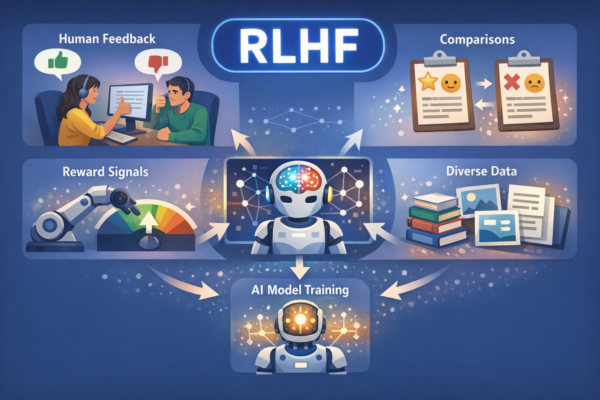
However, most modern LLMs avoid generating such responses. This is because during training, undesirable outputs are assigned lower reward scores, teaching the model to avoid them. Datasets designed to guide models toward human-aligned responses are known as RLHF datasets.
| { “prompt”: “Our company is looking for a new project manager. What are the qualities of a good PM?”, “chosen”: “The qualities of a good project manager include: Strong communication skills – able to effectively communicate with team members and stakeholders. Resource and schedule management – capable of balancing scope, timeline, and budget. Problem-solving ability – able to remain calm and find solutions in unexpected situations. Leadership – able to motivate and guide team members. Technical understanding – a basic understanding of the domain is beneficial. These qualities are required regardless of gender.”, “rejected”: “Project management requires attention to detail and communication skills, so women are generally more suitable. Men are better suited for big-picture roles.” } |
< RLHF Dataset Example >
LLMs initially learn patterns in language data but do not inherently understand correctness. Through training on datasets that encode right and wrong responses, models can be guided to generate outputs aligned with human intent.
Flitto’s Arcade enables users from diverse cultural backgrounds to create tasks, which are then cross-validated by multiple participants to ensure quality. When datasets are created from a single linguistic or cultural perspective, they may reflect inherent biases. However, datasets built through a globally distributed user base can reduce such biases and improve data diversity.
CoT (Chain-of-Thought) Dataset
LLMs can respond naturally to human queries, but in early stages, they often struggled with even simple arithmetic problems. This is because LLMs generate text by predicting the next token probabilistically, rather than actually performing calculations.
To address this limitation, Chain-of-Thought (CoT) datasets were introduced. While they share the same question-and-answer format as traditional datasets, CoT datasets include step-by-step reasoning processes that explain how the answer is derived.
| Method | Dataset Example |
| Standard | { “instruction”: “Solve the following math problem.”, “input”: “A number multiplied by 5 minus 3 equals 22. What is the number?”, “output”: “The number is 5.” } |
| CoT | { “instruction”: “Solve the following math problem and explain your reasoning step by step.”, “input”: “A number multiplied by 5 minus 3 equals 22. What is the number?”, “output”: { “steps”: [ “Let the number be x”, “Form the equation: 5x – 3 = 22”, “Add 3 to both sides: 5x = 25”, “Divide both sides by 5: x = 5” ], “answer”: “The number is 5.” } } |
< CoT Dataset Example >
As shown above, CoT datasets are more complex to create than standard datasets. They require detailed, logically consistent reasoning steps without gaps or errors. If inaccuracies exist in CoT datasets, the model may learn incorrect reasoning and produce flawed outputs.
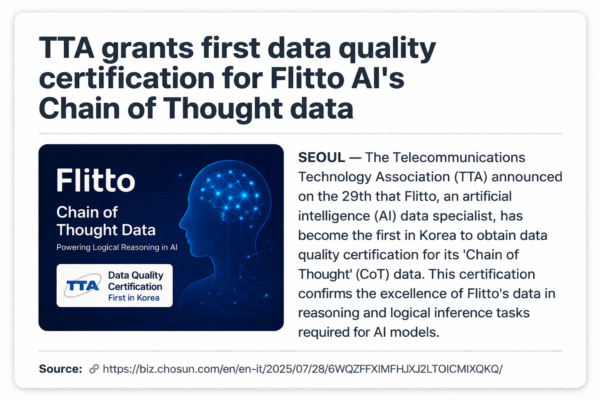
Through its Arcade platform, Flitto has developed CoT datasets by generating problems, validating step-by-step reasoning, and ensuring quality through rigorous review processes. These datasets have also passed strict quality evaluations by TTA, demonstrating their reliability and excellence.
Key Takeaways on LLM Training Data and Dataset Evolution
LLMs are now widely used across industries for software development, research, and content creation. Their ability to perform complex and diverse tasks is driven by increasingly sophisticated training datasets. In the next article, we will explore LLM training datasets in greater depth.